Transaction Center
Time to bring it home. Find zipForm®, transaction tools, and all the closing resources you'll need. Except for the champagne — that's on you.
View the latest sales and price numbers. Find out where sales will be in upcoming months.
Get a roundup of weekly economic and market news that matters to real estate and your business.
Gain insights through interactive dashboards and downloadable infographic reports.
All Shareable Reports All Interactive DashboardsCatch up with the latest outreaches and webinars by the Research and Economics team.
C.A.R. conducts research with members and consumers on a regular basis to get a better understanding of the housing market and the real estate industry.
California Model MLS Rules, Issues Briefing Papers, and other articles and materials related to MLS policy.
Looking for information on how to file an interboard arbitration complaint? You've come to the right place! Find the rules, timeline and filing documents here.
Summaries and photos of California REALTORS® who violated the Code of Ethics and were disciplined with a fine, letter of reprimand, suspension, or expulsion.
The most recent edition of the Code of Ethics and Standards of Practice of the National Association of REALTORS® along with other important links to NAR information.
The California Professional Standards Reference Manual, Local Association Forms, NAR materials and other materials related to Code of Ethics enforcement and arbitration.
Resources for Hearings via Zoom Online Training for Professional Standards Volunteers Professional Standards Webinars Professional Standards Film Festival Statewide Professional Standards Program Professional Standards Administrator Certification Arbitration and Mediation Forms Table of Contents Professional Standards Train-the-TrainerDesigned to expand housing access, Proposition 37 proposes a $25 billion state bond program providing eligible middle-income homebuyers with fixed-rate second mortgages covering up to 17% toward the purchase of newly constructed homes.
Updates on C.A.R.'s legislative advocacy efforts in Sacramento.
Ballot MeasuresIssues briefing papers, handbooks and other background materials on local policy issues that affect real estate.
CREPAC, LCRC, IMPAC, ALF and the RAF comprise C.A.R.'s political fundraising arm.
The RAA: Protecting REALTORS® and Homeownership REALTOR® Action FundC.A.R. Senior Vice President of Government Affairs Sanjay Wagle discusses the end of the 2025-2026 Legislative Session.
Learn how you can make a difference, by getting involved yourself or by passing along valuable information to your clients.


|
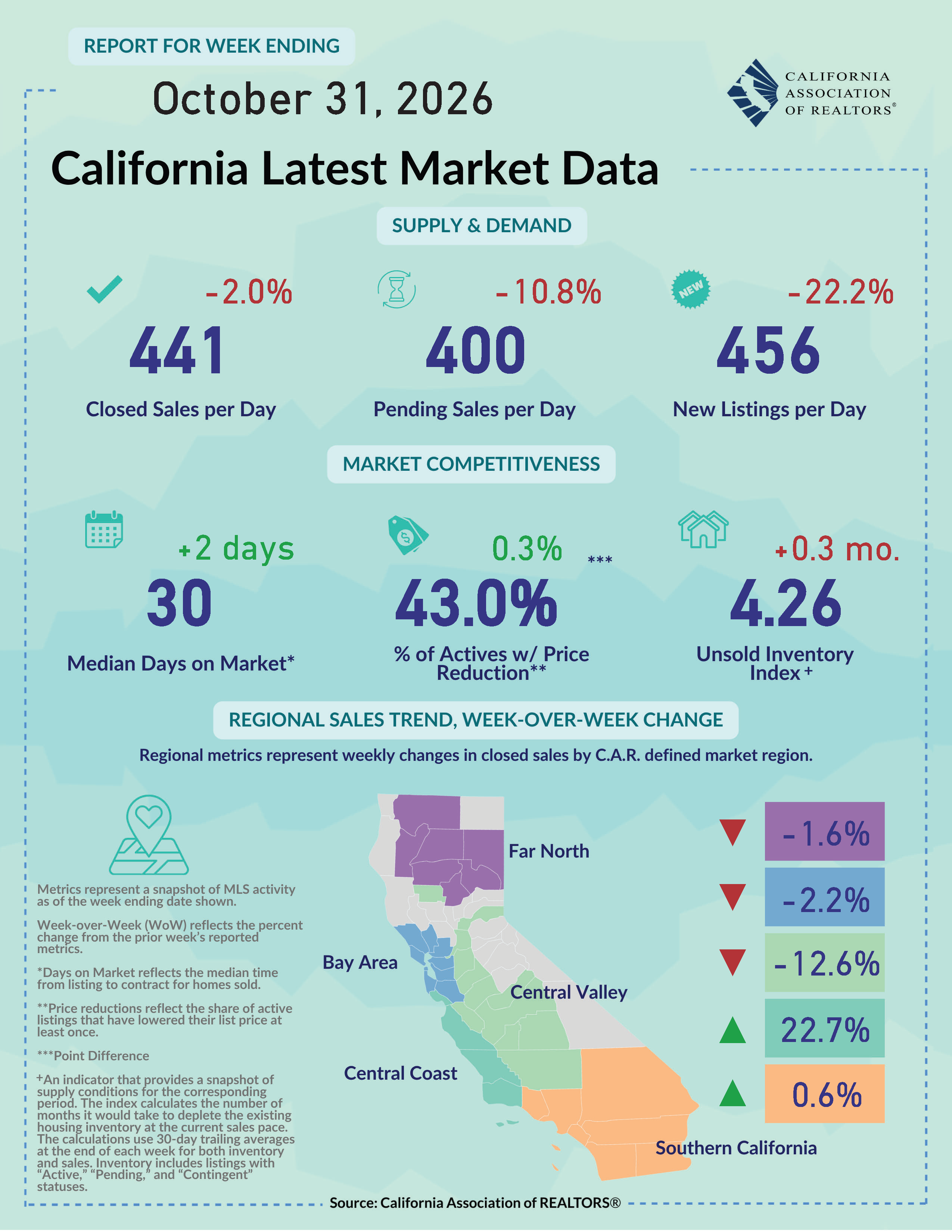
November 2, 2026 - While the latest new home sales report suggests that housing demand remains soft and market conditions are unlikely to improve much before the end of the year, market participants may be gaining a better sense of where the market is heading. The Fed's policy rate path is tracking market expectations, housing affordability is stabilizing, and the mid-term elections will conclude by the end of the week. Meanwhile, consumer confidence and the rental market are showing encouraging improvement. Together, these developments should bring more clarity to the market and the economy in the coming months. Fed keeps rates unchanged and offers no clear signal on December decision. The Federal Reserve voted at the latest Federal Open Market Committee (FOMC) meeting last week to keep its policy rate unchanged in a range between 3.75% - 4%. Two of the twelve FOMC voters dissented from the decision, with both pushing to raise rates by a quarter percentage point. Despite inflation remaining elevated, the central bank opted to take a wait-and-see approach at their last meeting before the mid-term elections. Fed Chair Kevin Warsh said at the post-meeting press conference that the September rate hike appeared to be gaining traction, with the financial and credit conditions tightening for some households and businesses. While interest rates are affecting investment decisions, capital spending remains strong and increasingly broad-based. Warsh also emphasized that labor market conditions remain “quite positive.” The 10-year treasury yield moved up right after the Fed meeting but pulled back the following day amid sell-off in equities led by technology. Mortgage rates ended the week at the lowest level in five weeks. Lower home prices offset higher mortgage rates as affordability stays flat. Housing affordability in California remained unchanged in Q3 2026, as declining home prices helped offset higher mortgage rates and kept monthly housing costs steady. The statewide Housing Affordability Index (HAI) for existing single-family homes held at 19%, unchanged from both the previous quarter and a year ago. The statewide median home price declined 2.3% from Q2 2026 to $894,630, while the monthly mortgage payment - including principal, interest, taxes, and insurance (PITI) - remained at $5,700, with a corresponding minimum qualifying household income of $228,000. Despite the quarterly stability, affordability remained challenging as mortgage rates surged in recent months and home prices stayed elevated in Q3. With inflation likely to remain high in the near term, rates may not moderate much by the end of the year and could continue to constrain purchasing power for potential buyers. New home sales dip as supply reaches lowest for the year. Sales of newly constructed single-family homes in the U.S. continued to fluctuate as September sales moderated by 0.6% to 676k from August’s revised 680k. On a year-over-year basis, the number of new homes sold last month remained below its year-ago level, with sales in September down 5.3% from last year, the biggest drop in the last five months. With homebuilders using mortgage-rate buydowns and other incentives to entice hesitant buyers, new home sales actually dipped less than expected in September despite rising rates. At the regional level, the West surged in new housing demand, with September sales jumping 21.4% from August but remaining down by 17.4% from their year-ago level. On the supply side, for-sale properties at the national level dipped for the second straight month, with months of supply sliding to 8.4 months from 8.5 months in August, hitting the lowest level since December 2025. Compared to 12 months ago, September’s supply was higher than the 8.2 months recorded in September 2025. With market conditions remaining lackluster, home prices continued to moderate from last year, with the median price of new homes sold in September reaching $400,000, a drop of 3.9% from a year ago, but an increase of 3.9% from August 2026. Higher mortgage rates will continue to challenge affordability in coming months, and new home prices could remain below last year’s levels again in Q4 2026. Consumer confidence improves in October as gas prices ease. Americans felt better last month as it took less for them to fill up their gas tanks, and their financial conditions looked slightly more favorable. The U.S. Consumer Confidence Index rose 7.5 points to 91.7 in October, up from 84.2 recorded in September, according to a monthly survey released by the Conference Board. Both the Present Situation Index and the Expectation Index recovered from the prior month, with the latter indicator - which reflects consumers’ short-term outlook - climbing for the first time in four months. The rebound was consistent with retail gasoline prices pulling back in the past few weeks from their recent peak reached in late September. While consumers remained concerned about their employment situations and jobs outlook, they felt better about their financial situations. On average, their inflation expectations over the next 12 months remained elevated at 5.8%, and fewer respondents planned to buy homes over the next six months. With interest rates flying high and consumers still feeling tight with their budgets, consumer confidence may only see incremental improvements in the coming months. Rent growth turns positive for the first time in over three years. Average U.S. rent growth for multifamily units had its first year-over-year gain in October after 40 months of annual decline, according to the latest Apartment List Rent Report. While the increase of 0.1% compared to October 2025 was very mild, momentum for rent growth appeared to be building as growth pace has been improving since May 2026. On a month-over-month basis, rents decreased for the second straight month, with a 0.3% decline in October to $1,384. Vacancy rate continued to decline since peaking in February 2026, with the national vacancy index sitting at 7.0% as of October 2026. While the latest figure was still above the long-run average, vacancy rate should slowly move towards levels that are more in line with balanced market conditions. Despite market conditions improving, nearly one-third (32%) of all properties were offering concessions valued at one month of free rent or more in October. The concession rate last month is higher than the 28% recorded in October 2025, which suggests that many markets continued to be competitive as demand remained soft. Note: This summary report gets updated every Monday by 6:00 pm PST. Feel free to email us at [email protected] if you have any questions and/or feedback.
|
|